
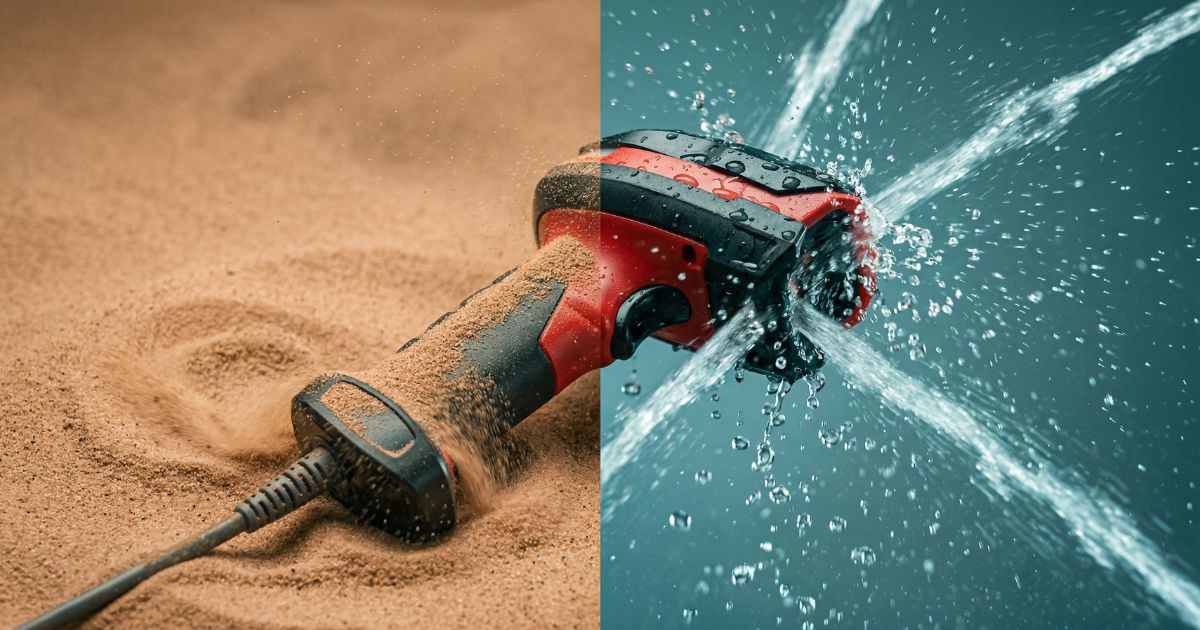
What Is IP Rating and Why It Matters for Industrial Scanners
The Two Numbers on a Spec Sheet That Could Save You Thousands
When you're evaluating a barcode scanner, IP rating often gets treated as a checkbox on a spec sheet rather than a meaningful decision factor. That's a mistake. Spec a device that's underprotected for your environment and you'll be replacing it in months. Beyond immediate costs, choosing the right rating is a pillar of operational sustainability (ESG)—devices that survive their environment longer reduce electronic waste and lower your long-term Total Cost of Ownership (TCO).
Overspec it unnecessarily and you've paid a significant premium for protection you don't need. Getting it right means understanding what those two numbers actually tell you.
IP stands for Ingress Protection, and it's defined by the international standard IEC 60529. The rating tells you how well a device's enclosure is sealed against solid particles — like dust — and liquid ingress — like water. It doesn't tell you about drop resistance, temperature tolerance, or chemical resistance. Those are separate specifications. But for many purchasing decisions in industrial and logistics environments, IP rating is the single most important durability indicator on the page.
What Does IP Stand For, and How Is It Tested?
IP is short for Ingress Protection, from the IEC 60529 standard published by the International Electrotechnical Commission. This is a globally recognized standard, which means an IP67 rating from a manufacturer in Taiwan means exactly the same thing as one from a manufacturer in Germany. The two numbers that follow 'IP' are each tested independently:
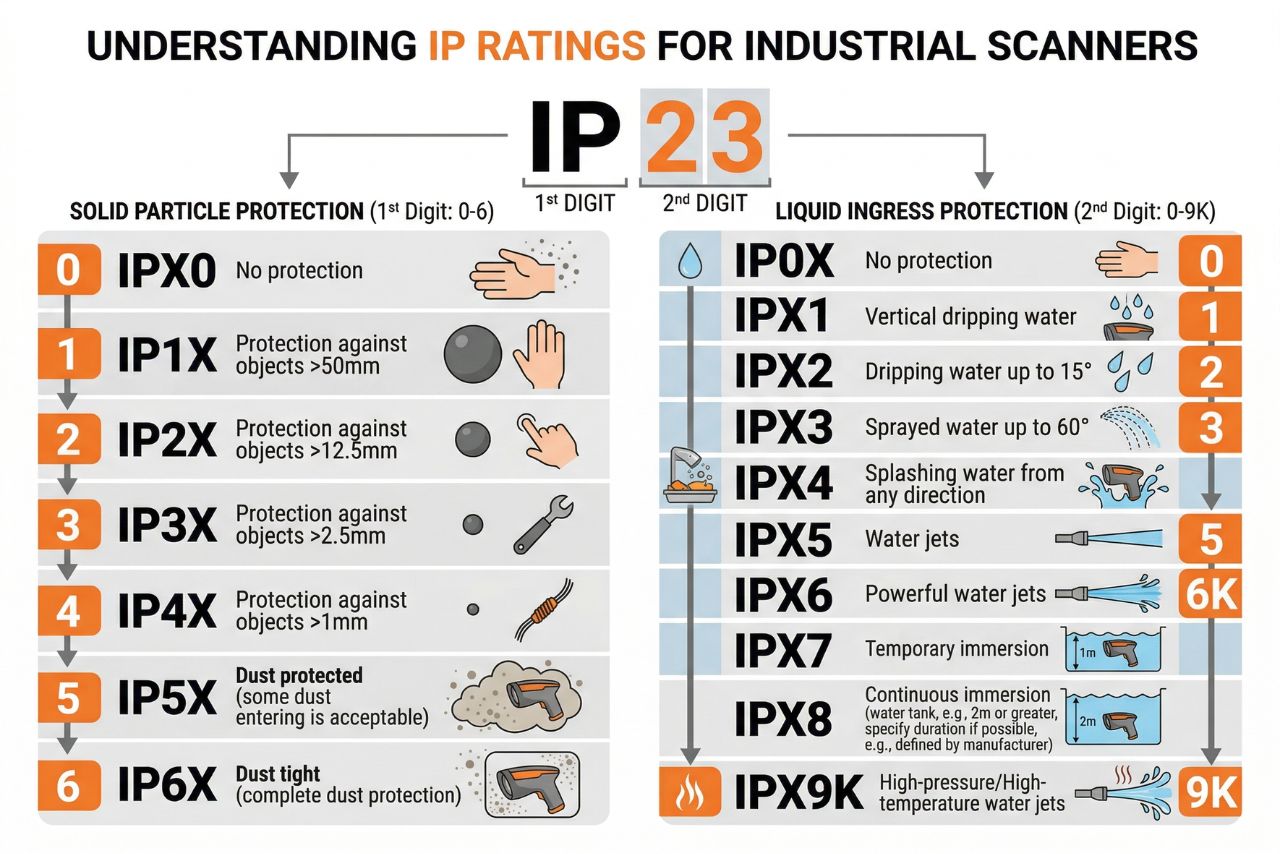
The first digit (0–6) indicates protection against solid particles, from no protection at 0 to complete dust-tight sealing at 6.
The second digit (0–9K) indicates protection against liquids, from no protection at 0 through various levels of splash, spray, and immersion resistance, up to high-pressure steam jet resistance at 9K.
An X in either position means the device hasn't been rated for that dimension — it doesn't mean it has no protection, just that it hasn't been tested and certified.
Breaking Down the First Number: Solid Particle Protection 0-6
In practice, most scanner purchasing decisions focus on levels 5 and 6:
Level 5 — Dust Protected
The device is not fully dust-tight, but dust cannot enter in quantities sufficient to cause harm. This is adequate for most indoor warehouse environments with normal dust levels and good housekeeping. You'll see this on many mid-range commercial and light industrial scanners.
Level 6 — Dust Tight
No dust ingress whatsoever. This is the requirement for genuinely dusty environments — woodworking, grain handling, construction materials, heavy manufacturing, or any environment where fine particulate is consistently present in the air. Once you specify IP65 or higher, you've already locked in level 6 dust protection.
Breaking Down the Second Number: Liquid Ingress Protection 0-9K
This is where most purchasing confusion happens. The levels that matter most for scanner selection:
Level 4 — Splash-Proof
Protected against water splashing from any direction. An IP54 device can handle an accidental spill or light splashing, but not a deliberate water spray or immersion. Suitable for clean retail environments and light industrial use where liquid exposure is incidental, not routine.
Level 5 — Water Jet Resistant
Protected against water projected by a nozzle from any direction. IP65 is the standard for environments that get hosed down as part of routine cleaning, or where moderate water spray is likely. This is the right starting point for most serious warehouse environments.
Level 6 — Powerful Water Jet Resistant
Protected against powerful jets from a 12.5mm nozzle. Stronger than IP65 water resistance, suitable for more intensive wash-down scenarios.
Level 7 — Immersion
Protected against temporary submersion in up to 1 meter of water for 30 minutes. IP67 is the standard for cold chain. and food distribution environments where condensation from moving between temperature zones creates consistent moisture exposure, or where a device might be accidentally dropped into water. This isn't just about water splashes; it’s about physics. Condensation when moving a device from freezer to ambient temperature creates a vacuum effect that can pull moisture into the device’s seals. IP67 provides the necessary barrier.
Level 8 and 9K
IP68 extends immersion protection beyond 1 meter (exact parameters are manufacturer-specified). IP69K adds protection against high-temperature, high-pressure steam jets — required for food production and pharmaceutical manufacturing where equipment undergoes intensive sanitization.
Common IP Ratings for Barcode Scanners and What They Mean in Practice
| Environment | Recommended IP | Typical Conditions | Device Type |
|---|---|---|---|
| Retail store / office | IP42–IP54 | Light dust, occasional spills | Standard commercial scanner |
| General warehouse / factory | IP54–IP65 | Dust, water splash, cleaning | Mid-range rugged handheld |
| Loading dock / semi-outdoor | IP65 | Rain, hose-down cleaning, moderate dust | Industrial rugged unit |
| Cold chain / freezer entry | IP67 | Condensation, moisture ingress | Low-temp rated, IP67 |
| Food processing / wash-down | IP65–IP69K | High-pressure cleaning, chemicals | IP69K rated device |
| Outdoor / field service | IP65–IP67 | Rain, dust, mud | Full rugged outdoor unit |
Matching IP Rating to Your Environment
A few practical rules:
- If you're not sure whether your environment needs IP65 or IP67, choose IP67. The cost difference between adjacent IP levels is usually modest compared to the cost of replacing a device that failed at the wrong moment.
- Cold chain environments almost always need IP67 or higher. As discussed, the condensation when moving a device from freezer to ambient temperature is a real and frequent source of moisture ingress.
- Food processing and pharmaceutical environments often require IP69K. Confirm with your operations team what cleaning protocols are in use — high-pressure, high-temperature wash-down is a different requirement from occasional splashing.
- Retail environments without a back-of-house receiving function rarely need more than IP54. Investing in IP65 or higher for a POS checkout scanner is usually over-speccing.
IP Rating Is One Part of the Picture
IP rating tells you about environmental sealing. It doesn't tell you whether the device will survive a 1.5-meter drop onto concrete, what temperatures it can operate in, or whether the screen is readable in outdoor sunlight. A complete durability assessment for an industrial scanner should also check:
- Drop specification in meters onto concrete or steel (not padded surfaces — real-world drops happen on concrete)
- Operating temperature range, particularly if you have cold storage or outdoor exposure
- MIL-STD-810 certification, which covers shock, vibration, humidity, altitude, and temperature cycling as a broader durability framework
- Scan window material — a polycarbonate scan window is more impact-resistant than standard glass
IP rating is a necessary specification, but it's not sufficient on its own. Use it as the starting filter, then validate the rest of the durability picture before finalizing your hardware selection.